The floor slab’s down

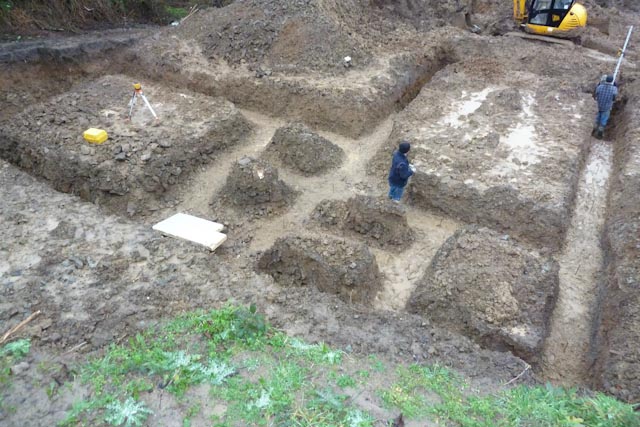
The weather over the couple of weeks following my last post, when the concrete was poured, continued to be dire.  While the east of England has had the driest winter for many years, Devon seems to have been deluged.  Serious thoughts of building an ark, rather than a house!  Brian, the groundworker, said that the weather had turned ‘..a difficult site into a near-impossible one…’.  The ground conditions were terrible, slippery mud that sucked your boots off if you stood still for more than a few seconds.  The tracked excavator was stuck in the mud, and the standing joke was that we could put some hanging baskets on it and use it as a garden ornament.

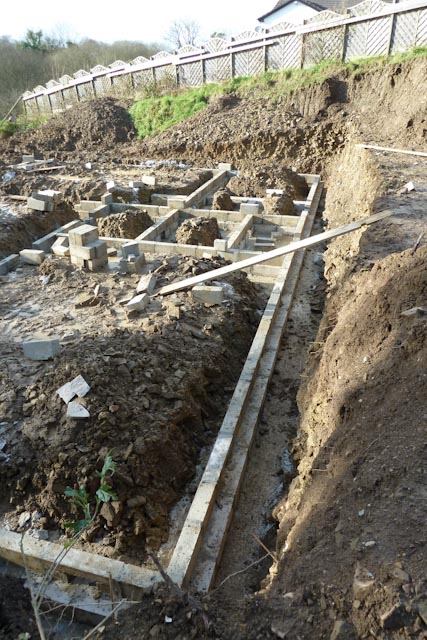
Fortunately, the weather over the last couple of weeks has been drier, and work on site has been possible.  By the end of January, we could see the blockwork walls that would complete the foundations…

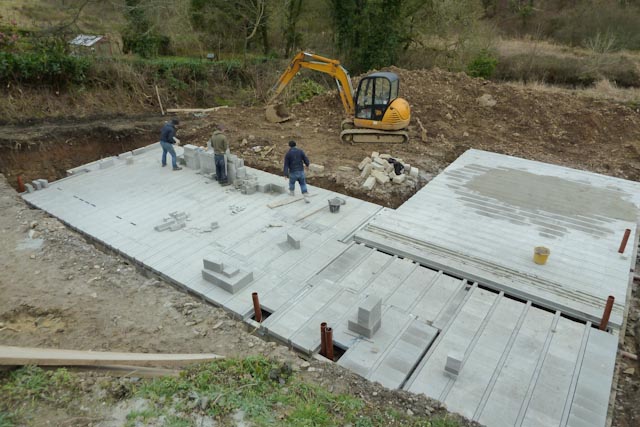
But then work seemed to pause for a while, as we had more rain.  But yesterday, we went to the site and were stunned to see the floor slab in place…

The beams had been craned directly into position – just as well, as manual handling would be impossible for the 5m long, 200mm deep reinforced concrete beams – and most of the whold blocks were in place.  Most of the projecting pipes are the drainage tails for soil and vent pipes, though the two close together in the foreground are ducts for the header pipes to the ground-source heat pump from the bore holes.

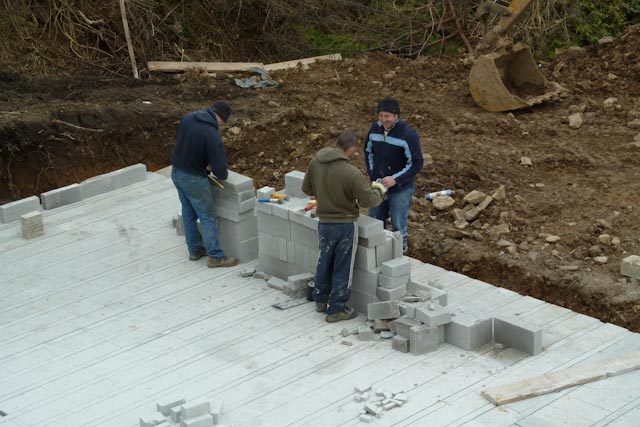
The guys were working on filling in the remaining gaps with cut blocks..

prior to grouting the surface.

CONCRETE!!!!!

Yes, at last, after delay, storm, tempest and flood, the concrete went into the footings today.  An immense sigh of relief, and, at last, the feeling that we are actually building something.

Last week’s floods had subsided within a couple of days, but the ground round the excavations remains very muddy – stand still too long and you lose your boots.

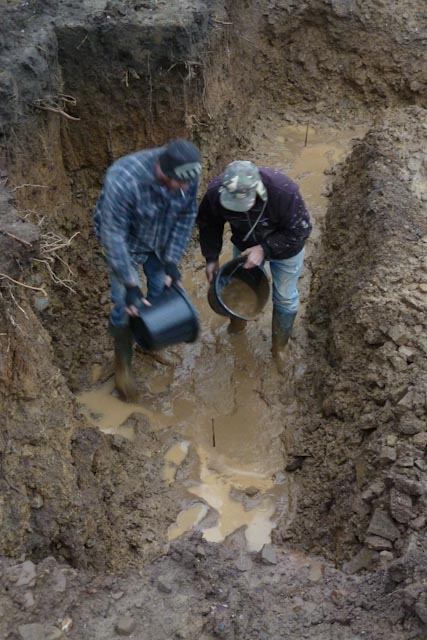
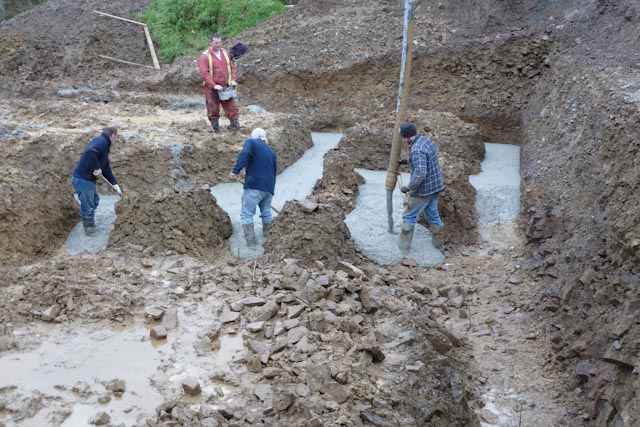
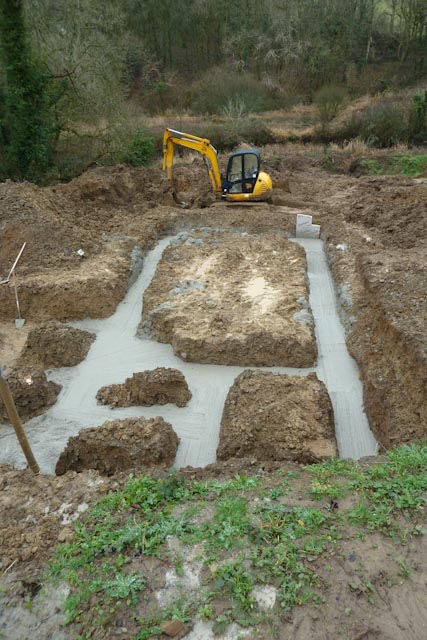
This shows the trenches at aboout 9:00 this morning.  The NHBC inspector had been to site yesterday, and approved the trenches, subject to my confirmation that they were still clear, and that the surplus water was removed.

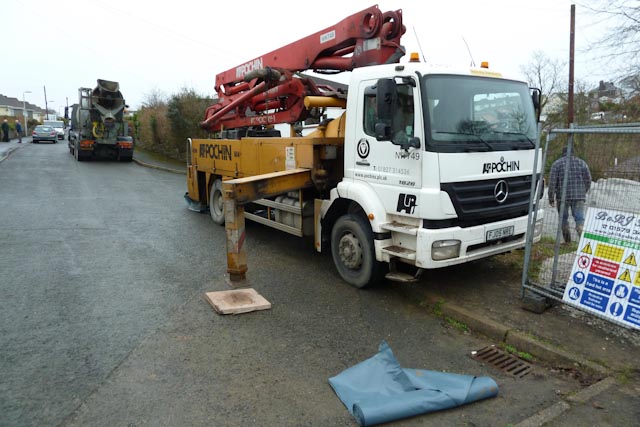
The groundworkers set to with buckets and shovels, and took out most of the water, leaving a sort of muddy slurry in the base of the trenches.  Then, bang on time at 9:30, the concrete pump arrived.

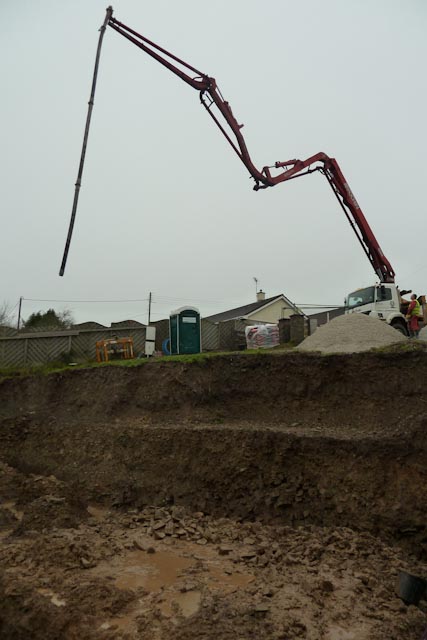
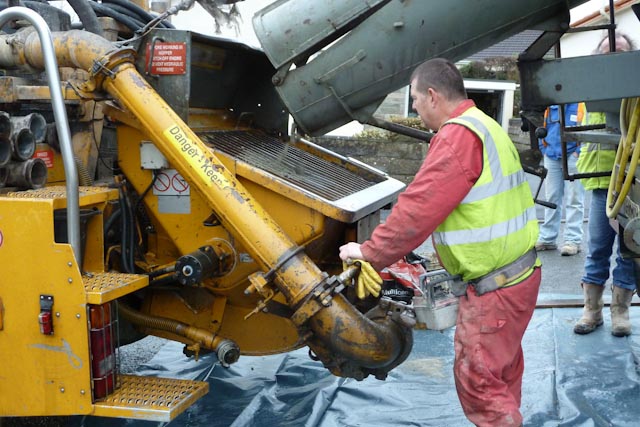
Followed shortly by the first concrete mixer, with 6m3 of concrete.  The pump has a long, extending nostril, and pumps concrete fed into a hopper at the back of the lorry.

Filling up the trenches really didn’t take long.

Here’s the result, before the arrival of the third and final lorry-load of concrete.

So now, 20m3 of concrete in the ground, we really start building.  Blockwork up to damp-proof course level next.

We now have a hole full of water

Monday night and Tuesday morning saw the UK swept by fierce winds and heavy rain.  Looking out the window on Tuesday morning, watching the rain going past horizontally, it was inconceivable that Brian the groundworker would be able to do anything today.  When the NHBC inspector rang to confirm his visit, my inclination was t0 cancel on the spot.  But a few phone calls later, we established that Brian’s men were on site and expecting the inspector that afternoon, with the intention of pouring the foundation concrete on Wednesday – the concrete pump was booked.

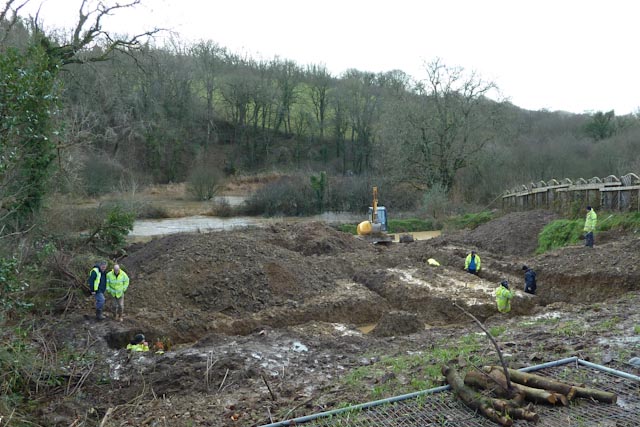
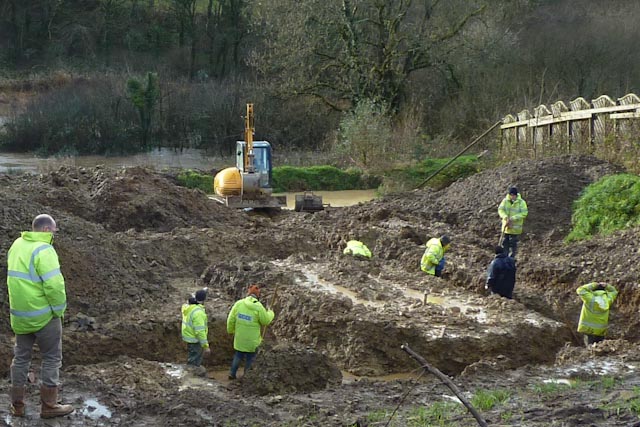
The drive up to Holsworthy was interesting – water pouring out of the fields, huge puddles everywhere. The river at Ashmills had burst its banks, and the rain was still coming down in buckets.  When we got to the plot, this is what we saw…

The groundworkers were wading around in the trenches, removing the loose spoil and trying to remove some of the water

Water was flowing into the foundations, percolating through the ground from the hill above, and filling the trenches as fast as they could bail it out.  No prospect, then, of the NHBC signing off the foundations as ready for concrete!  So we cancelled the concrete pump, and agreed that we would try again on Friday, as the weather forecast for the next few days was drier.

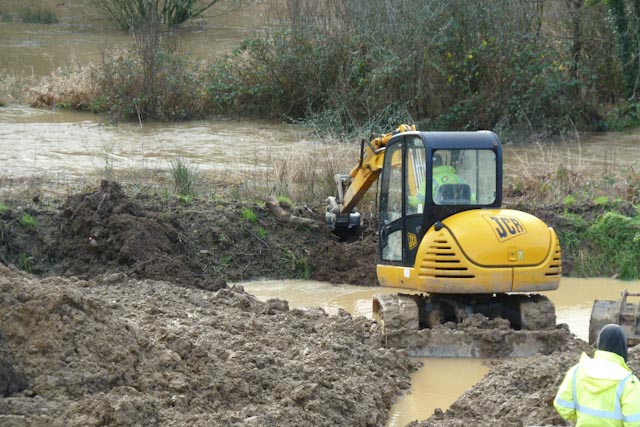
Meantime, how to help the site drain better.  One of the groundworkers suggested punching a gap in the bank at the bottom of the plot…

5 minutes with the JCB later, we had a drain, and the satisfaction of seeing the water running away.

Until Friday, then!

We now have a hole in the ground

It’s been a frustrating few weeks since the last post.  We thought that the groundworkers were starting about 7 November, but not much happened. Jerry did show up with his excavator, strip some of the re-grown vegetation, and dig the trench for the temporary water supply, but then things stopped.  And the weather got dire.  And we heard that Brian (primary groundworker) was off sick.  And nothing happened.

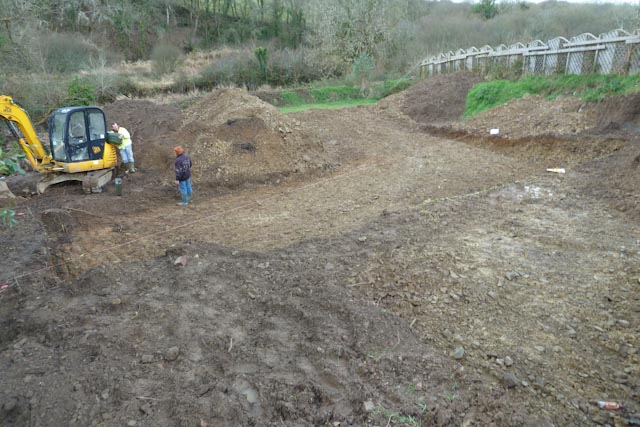
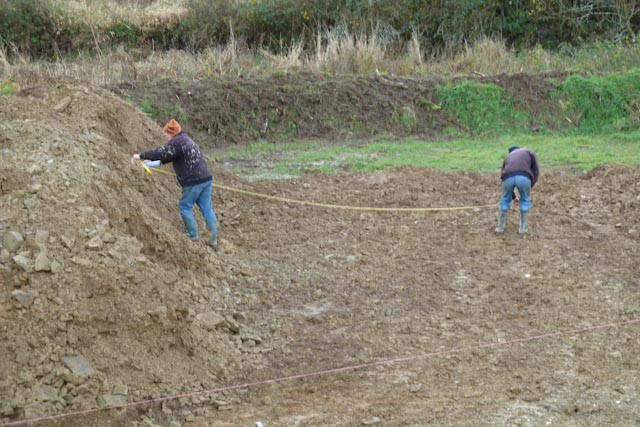
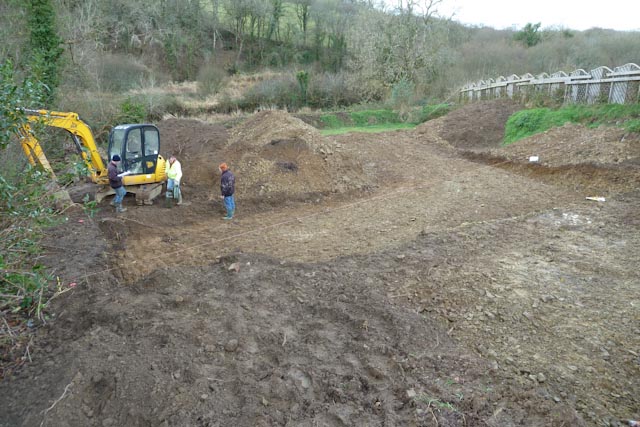
At last, though, this week, we have seen some real progress.  Today, Jerry and his colleagues are setting out the slab foundations,

ready to dig the trenches for the foundations on Monday/Tuesday, ready for concrete Wednesday or so.


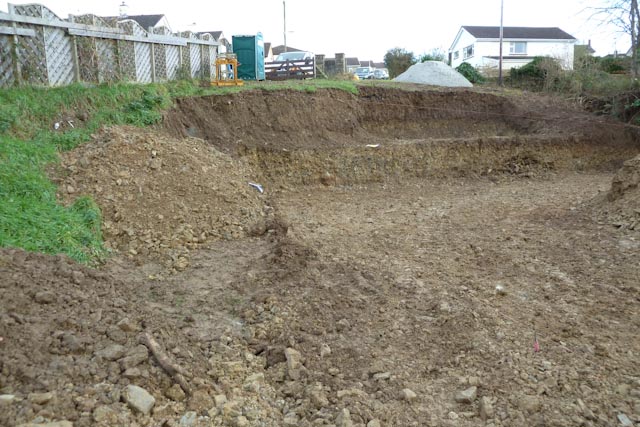
This picture is looking back from the (south) west corner of the house, towards Holsworthy town.  The level area nearest to the camera is roughly at the ground level below the ground-floor slab: the floor level will be ~400mm above this, allowing for the underfloor space and the thickness of the beam-and-block floor.  The cutout towards the top of the picture is for the store rooms that will be located under the garage, which will be postioned roughly where the heap of sand at the top of the picture is.

We have to work out what to do with the heap of spoil…

…in the middle of this picture.  Some of it will be used to back-fill behind the retaining walls, but we shall probably use the remainder to raise the level of the garden below the house.  We shall see!

Inching forward

We’ve just received the draft report from the geotech engineers, and, happily, the news is good.

They had dug 4 “trial pits” on the site – holes about 2m x 1m x 2m deep – looking at the nature of the soil, trying to find bedrock, and taking samples for testing (for compressibility etc) and analysis for contamination.

Their report, which runs to 12 pages, plus 20 more of tables and photographs  – yes, photographs of holes in the ground (and I thought my photography was a bit odd!) – will confirm that the site had not previously housed an incontinent arsenic-and-cyanide processing oil refinery, and it’s not based on a mixture of clay and quicksand over a geological fault!  So the house shouldn’t subside into a pit or poison us over the next ten years.  Also, the requirements for the foundations should not be any more difficult than we’d expected.

There’s still some more box-ticking to do with NHBC, but we are inching, ever so slowly, towards actually starting to build something.

Something’s happening, well almost!

In my last post, I wrote that the groundworkers were due to start work on 15 August. All was going well until the Tuesday before they were due to start, when Sean the project manager called and told us that NHBC, the structural warranty insurer and building regs inspector had written requiring that we carry out a geotechnical survey of the site.  We had not expected this; a few short words later, we found that the investigation was likely to cost about £4,000 (ouch!) and take up to 8 weeks (ouch again!).

So, a hastily constructed Plan B emerged.  Sean and I met Brian Philips, the groundworker, and agreed that he would clear the vegetation from the site, and have a digger (machine and man) to dig the trial pits that the geotech company required.  This being building, Brian had another job that overran, so rather than starting on 15 August, he actually started yesterday – 22 August.

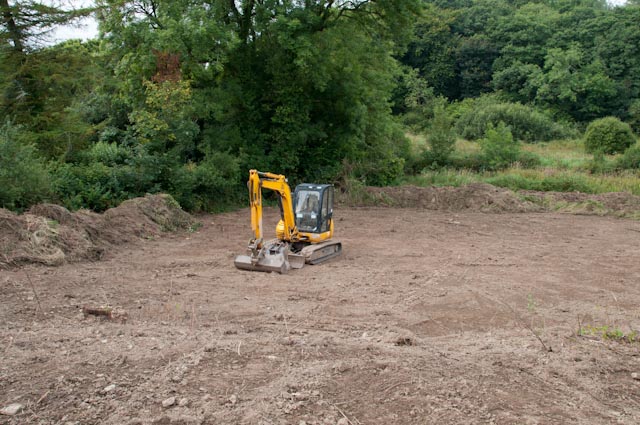
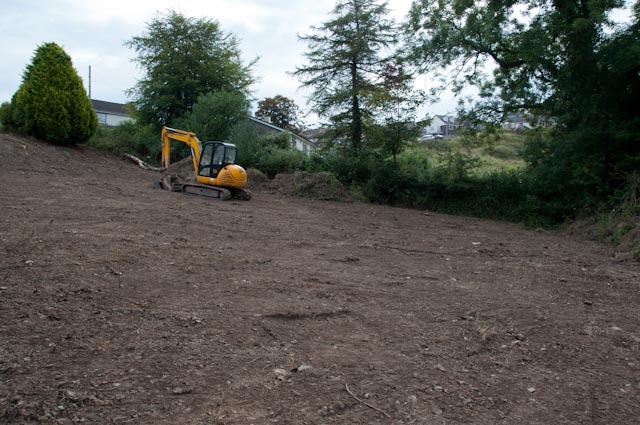
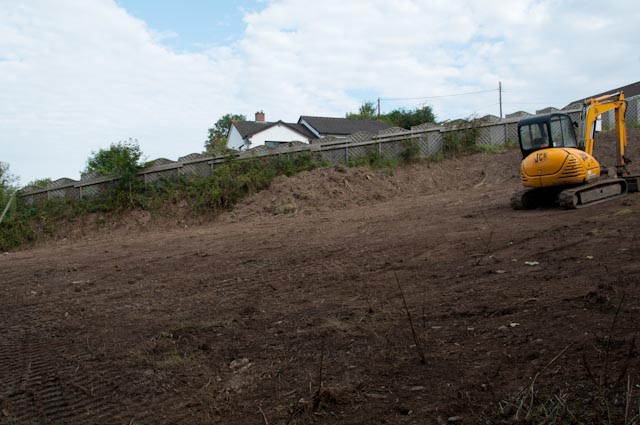
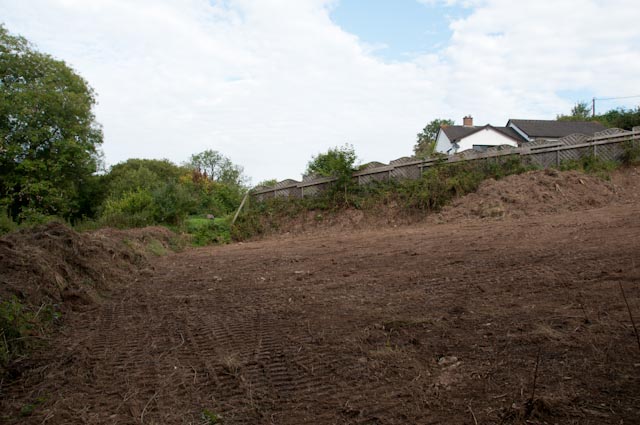
But, at last, miraculously, the overgrown vegetation is gone….

The vegetation's gone..

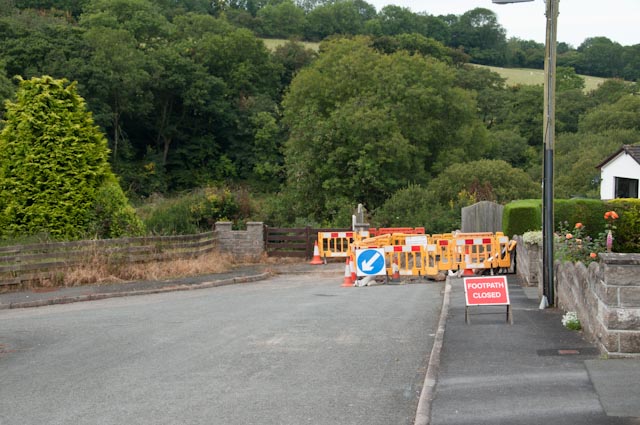
The other piece of work that’s underway is the provision of electricity to the site.  That entails Western Power Distribution digging up the road outside…

Western Power Distribution's 'improvement' to Westcroft Road

Hopefully, WPD will finish this today (Tuesday), so that South West Water can come and dig it all up again to lay in the water supply!

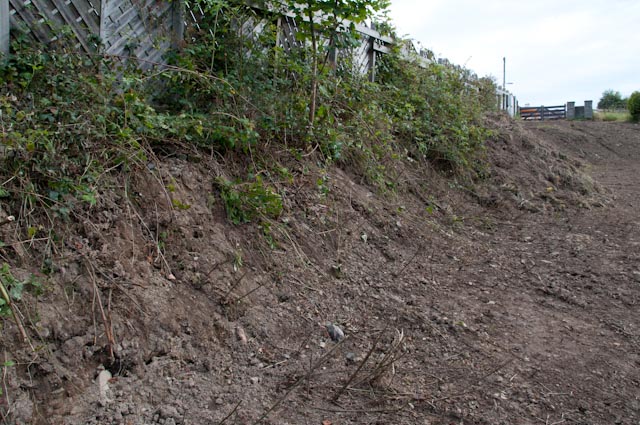
But at least, now, we can see the site without the thickets.  Here are some more pictures

Things are in place

At last, we have a date to start work on site: the groundworkers are scheduled to start in the week commencing 15 August, with their work taking about 6 weeks.  This is the step that essentially unlocks the whole build programme, and should let us (or Sean, our project manager) put together the whole schedule.  In the meantime, we have done a host of things contributing to the build:

  • We have organised, submitted and got approval for the landscape design for the garden. This was the only ‘pre-commencement’ condition on our planning permission, which meant that we had to get the garden basically designed, and submit the design to Torridge for approval,  before a sod could be turned.  Sean introduced us to a landscape designer, Jane Stewart, who did the work for us, and created what we think and hope will be a lovely garden to complement the house and link it to the landscape.  The designs are here (be patient – it’s a big file).
  • We had to have the foundations and retaining wall designed by structural engineers.  Our site is not the easiest, with a steep slope or bank in the middle of it.  The house takes advantage of the slope, but it does require more extensive sub-structure than a house on a level site.  Sean recommended that we use Paul Carpenter Associates for this work.  They produced a detailed design that meets the structural requirements, but should be reasonably straightforward to build (we hope!)
  • We have ordered water and electricity supplies.  No, they don’t just appear by magic – you have to pay for the man to connect the pipes/wires!
  • We’ve bought our structural warranty, and the building regulations inspections.  We are using the same organisation (NHBC) for both, so that we have a single inspector.  He is unlikely to disagree with himself over what is required.
  • Finally, Sean tendered the groundworks.  We got four tenders, with a price range nearly 50% of the cheapest.  Not sure how that works, but we have now chosen one (not the cheapest, but certainly not the most expensive), who can start in a couple of weeks.  Then the fun really starts!
It’s been a while, but..

My last post here was at the end of March, when we had placed our order with Potton for the timber frame.  That triggered a series of steps, that have take until now to work through.  I said then that we hoped to start groundworks in May – so much for hope!

Placing the Potton order let us start work with them on finalising the design – the layouts that we had at that point were definitel V0.0, and we knew that we would need to make some changes.  The overall size of the building was fixed, but we were able to review (and amend) the internal layout.  The result is here, in the Potton Rev D drawings.

The main amendments are the room in the roof space, and some changes to bathroom layouts.  It seemed a bit bizarre, considering that all we had were some lines on paper, but we spent ages looking at kitchen and bathroom fittings catalogues, and talking to suppliers of things we won’t need for several  months, but we needed to make fairly rigid choices for fittings, so that we could be sure that we could fit in what we wanted.

The result has a few differences from the original design for which we had planning permission, but we were assured that the council would treat them as minor amendments.  Until, that was, I spoke to the planning officer at Torridge Council, who didn’t actually suck her breath through her teeth, but told me, with no scope for negotiation, that we would have to apply for new permission.  So that was what we did.

Fortunately, because the new application was within 12 months of the original permission, we could use our Free Go and didn’t have to pay the £335 fee. But it did mean, in essence, that we were stalled for up to 8 weeks.  We had to go slightly ballistic when we learned that Holsworthy Town Council had recommended refusal of our application, citing ‘grave concerns…’.  An ‘assertive’ letter from us (I hope) put them straight (the planning officer at Torridge referred to it as ‘useful’), and shortly after, we got our new permission.

That’s not the end, but I’ll continue in another post.

Ordering the Timber Frame

This week, we took the first big step, by placing an order with Potton for the timber frame that will be the core of our new house.  We had already seen Potton’s initial drawings, created from those in our planning application, and, on Monday, we had a long meeting with the Potton Regional Manager, Sean Adams, and our Project Manager who, to save confusion, is also called Sean.

This involved making a whole load of choices – down to the colour and style of the door handles – then handing over a (substantial) cheque.  For the project as a whole, this means that (a) we are committed to the Potton timber frame, and (b) that we have a better idea of timescale.  We are now looking at starting on groundworks towards the end of May, so that the timber shell would be erected by early July, and we should have a weatherproof building – windows and doors in, roof tiled – by August, hopefully before the monsoon.

We expect to have the next Potton iteration on the drawings next week – more then.

First steps on the new build

In the four weeks since I last posted anything here, we have been steadily getting settled here in Devon, and have finally started with some concrete actions to get our new build in Holsworthy started.

To this point, we have not been committed to a particular builder, or to a specific build method.  The design we submitted for planning permission last year rather assumed a ‘conventional’ (for England) construction in brick and blockwork, but that was not implicit in the design.  In the interim, I had done some research that suggested that one of the timber-based construction techniques could be beneficial for us, in terms of build speed (important when the weather can be so unpredictable), and thermal insulation (important for obvious reasons).

We’d already spoken to a couple of timber-frame specialists, Scandia Hus and Potton, both of whom supply a timber frame package including the supply and erection of the structural frame of the house, windows and doors.  My subsequent research led us to look at a relatively new technology, SIPs (Structural Insulated Panels), which has been described as timber frame without the timber frame.  The house would be built from structural panels made from two plywood (well, actually oriented-strand board, OSB) sheets bonded to either side of 100mm or so of rigid plastic foam insulation.  We talked to a couple of SIPS suppliers, in most detail to a small, Redruth-based company called Building With Frames.

We also had a meeting with the architect who had done the original design, and had acted as our agent for planning permission, Alf Trewin.  Alf proposed a conventional, architect-managed build, using a prime contractor.  It was clear that, using this process would achieve an excellent result, but we were concerned that:

  1. there was lots of potential for the cost (already high) to drift up and up;
  2. we would have less control over the whole project than we wanted.

So we followed up Building with Frames and Potton some more.  Interesting meetings with people who clearly know what they are about, and who clearly wanted to be involved.  The key considerations for us were

  1. confidence that whoever we went with could and would do a good job for us
  2. financial security – we are, after all, committing a lot of money to this project!
  3. performance of the finished house, particularly in terms of thermal insulation and airtightness
  4. people we were comfortable to work with.

I had started with the assumption that SIPs offered better thermal insulation (lower U-value) and better airtightness than (Potton’s) timber frame, but I found out that this was not (necessarily) the case.  We gave both Potton and BWF a fair grilling; whilst both responded well to our heap of questions, we came away with the feeling that Potton would be the lower risk option, and would certainly do a good job.  So that was our decision.

We are going to employ a professional project manager, to manage the project (!) day to day, while leaving us in overall control.  This will give us the benefit of his experience and contacts in the building trade, and should save us money overall.

Sean Adams, the local Potton representative, has now taken our design brief, and should be back next week with draft drawings.

Then the fun really starts!